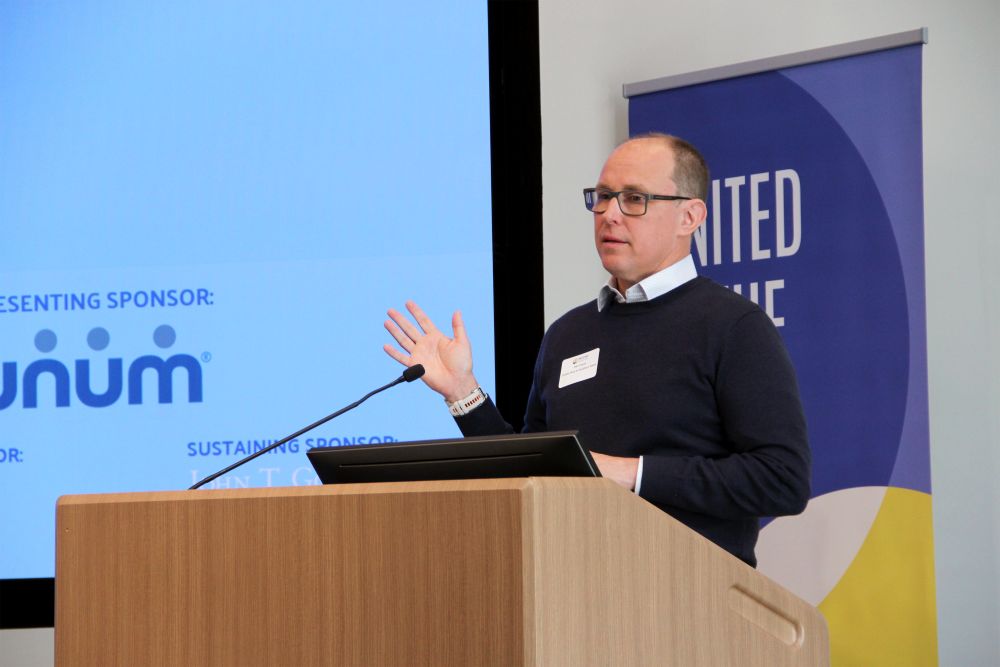
This month marks Dan Coyne’s first year as president and CEO of United Way of Southern Maine, a role he stepped into after more than a decade with the organization. In this conversation, Dan reflects on the past year, what he is hearing and seeing in our community, and where United Way is headed in the future.
What felt most different about stepping into the CEO role after so many years with the organization?
Stepping into the CEO role required me to think more broadly about the organization and the special role it plays in community for making measurable change possible. What’s been both humbling and energizing is realizing how deeply people across this community care about United Way’s role, and how much they expect from us.
Our donors, volunteers, and advocates, along with former and current staff, have built such a strong foundation. Feeling that level of trust has strengthened both my sense of responsibility and my optimism for what we can accomplish together.
Looking back on your first year, what stands out as the most meaningful insight you’ve gained about United Way and the community we serve?
The most meaningful insight has been just how interconnected our challenges and strengths really are. Whether I was talking with community members, partners, or staff, the same themes rose to the top: people want stability and opportunity.
And they see United Way as a problem solver—an organization that can bring people and resources together to address challenges in ways no single organization can. That reaffirmed for me that our greatest value isn’t only the dollars we invest in community, but in our ability to create alignment and momentum to drive change. We provide an easy way for people to gather and channel their generosity, whether it is their time, talent, and/or treasure.
Your first year included significant listening to community voices. What challenges and opportunities have you been hearing?
We set a bold goal for this year: to hear from at least 3,000 Southern Mainers about their dreams and aspirations. These community conversations have been especially powerful. Our team has spent time with donors, partners, and residents, and as an organization, we’re sitting face-to-face with people—young people, older adults, veterans, families—and hearing directly about their hopes and their struggles.
We live in an uncertain time. Many of the people we spoke with are wondering if they are ever going to get ahead – can they buy a house or rent a nice apartment, send their kids to affordable but high quality child care while they are working, and avoid the impossible choice between putting food on the table or filling their prescriptions.
People want stability and support that feels accessible. Those conversations didn’t just deepen our understanding; they helped shape our priorities for the work ahead.
Despite the uncertainty many feel, I also sense profound optimism, in large part because of our community’s collective sense of possibility, generosity, curiosity, and committed action. There is optimism that we can work together to solve problems that no one organization can solve. This leaves me believing we can seize an incredible opportunity to define community – one in which everyone has the opportunity to thrive.
Having already known United Way well, what aspects of our culture did you want to preserve—and what did you hope to evolve in your first year as CEO?
I’ve always valued our culture of caring and curiosity. Our people show up for each other and for this community in genuine and meaningful ways, and that’s something I never want us to lose.
At the same time, we are strengthening our problem-solving muscles. There are so many needs in community, with structural issues making it hard for so many families to make ends meet. These families (ALICE, which is short for Asset Limited, Income Constrained, Employed) walk a financial and emotional tightrope – they are one car repair or missed utility payment away from catastrophe. Our friends, family, neighbors, and community members who are struggling need us to innovate faster and implement solutions, like United 4 Child Care.
As you look at the next chapter, what excites you most about where we’re headed?
I’m excited about the opportunity to define – together – a new community vision. We have a chance to build something that simultaneously reflects today’s realities, today’s voices, and today’s aspirations while increasing generational opportunities.
United Way was built to address community issues that don’t have easy, simple fixes. We are perhaps best known for investing in other organizations, but we also run our own programs, like CA$H’s free tax prep or sending volunteer readers to local schools. What we’re hearing from community is going to drive the programs we offer and how we serve our community going forward.
What inspires me most is the level of deep engagement we’re seeing—from partners, donors, businesses, volunteers, and advocates who want to play a role in shaping solutions so that everyone can thrive. I believe we’re entering a period of renewed clarity and purpose, and I’m confident that the work we’re doing now will position us for even greater impact in the years ahead.